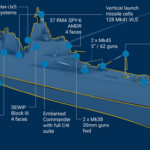

DDG-126. The Navy christened the future USS Louis H. Wilson Jr. (DDG-126), during a Sept. 27 ceremony at General Dynamics Bath Iron Works (BIW) in Bath, Maine. The ship is named after a World War II and Vietnam War veteran who was awarded the Medal of Honor for performance in the Battle of Guam and served as the 26th Commandant of the Marine Corps from 1975 to 1979. DDG-126 is BIW’s first DDG-51 Flight III destroyer, which was designed to include upgrades to accommodate the ANSPY-6(V)1 Air and Missile Defense Radar. Other ships in production at the facility include the future Flight IIA Harvey C. Barnum Jr. (DDG-124), and Patrick Gallagher (DDG 127) as well a Flight III destroyers William Charette (DDG-130), Quentin Walsh (DDG-132), John E. Kilmer (DDG-134), Richard G. Lugar (DDG-136), and J. William Middendorf (DDG-138).
…DDG-128 Trials. HII’s Pascagoula, Miss.-based Ingalls Shipbuilding announced the successful completion of builder’s sea trials for the future USS Ted Stevens (DDG-128) Flight III Arleigh Burke-class destroyer. This is the second Flight III destroyer built by HII, a variant with design modifications to host the AN/SPY-6(V)1 Air and Missile Defense Radar (AMDR) and the Aegis Baseline 10 Combat System. Trials occurred over several days in the Gulf of Mexico to test the ship’s engineering, navigation, and combat systems to ensure readiness for later acceptance trials delivery to the U.S. Navy. Beyond DDG-128, the company said it has four more Flight III DDGs under construction: the Jeremiah Denton (DDG-129), George M. Neal (DDG-131), Sam Nunn (DDG-133) and Thad Cochran (DDG-135).
Shutdown and Aerospace. The ongoing federal shutdown will affect the U.S. aerospace and defense industry’s 2.2 million jobs, according to the Aerospace Industries Association (AIA). The fiscal 2026 funding hiatus “will disrupt new programs, halt innovation, slow the FAA, and more,” says AIA President Eric Fanning said. “With this shutdown also comes a lapse in authorization for three programs our industry relies on—Small Business Innovation Research [SBIR], Cybersecurity Information Sharing Act, and the Defense Production Act. As Congress works through fiscal year 2026 appropriations, we urge them to make meaningful progress that maintains mission-critical functions—especially for the Pentagon, FAA, and NASA—and extends these essential programs.”
…SBIR Debate. Last Tuesday, amid the debate on a fiscal 2026 continuing resolution, Sen. Edward Markey (D-Mass.), the ranking member of the Senate Committee on Small Business and Entrepreneurship, proposed that the Senate agree to unanimous consent on the House-passed H.R. 5100 bill to extend SBIR and Small Business Technology Transfer programs for one year to allow legislators to discuss needed reforms. Yet, Sen. Joni Ernst (R-Iowa), the committee’s chairwoman, objected and proposed just a one-month extension amendment. The latter would have established a “reasonable lifetime limit on SBIR funding, which would affect only .2 percent of participants in the program” and “counter Chinese espionage by standardizing the foreign risk definition across our federal agencies,” she said. Ernst introduced S. 853, the Innovate Act, in March–a bill that she said is targeted at SBIR reform to crack down on what she has called “SBIR mills.” “In the past decade, 25 companies alone in the Pentagon’s SBIR program received 18 percent of the funding,” Ernst said on the Senate floor on Tuesday. “A single company received $650 million—more award dollars than the total issued to all companies in 26 states combined…Additionally, companies linked to our adversaries funnel taxpayer-funded intellectual property into communist China and beyond.” The company receiving the $650 million in SBIR awards since 1983 is the Massachusetts-based Physical Sciences Inc., which develops advanced health and defense technologies, such as the InstantEye small reconnaissance drone.
Persistent/NGC2. Persistent Systems said on Oct. 2 it has received a $34 million order from the Army to supply the 4th Infantry Division with its Wave Relay mobile ad hoc networking (MANET) devices in support of the Next Generation Command and Control (NGC2) prototype initiative. The award follows Persistent’s participation in the Army’s most recent Project Convergence experiment where the company provided its MANET capability to help inform NGC2 efforts. “During the exercise, the company’s Wave Relay MANET demonstrated the scalability and network capacity to transport massive amounts of data from cameras, sensors, and software systems across an armored battalion on the move. The enhanced communications capability enabled M1A1 tanks and Bradley Fighting Vehicles to coordinate a combined arms breach, a complex tactical maneuver, with precision,” Persistent said in a statement. The Army has said NGC2 will provide “commanders and units at echelon an open and modular C2 ecosystem across hardware, software and applications with access to a common and integrated data layer,” and has described it as a “fundamental change in how the U.S. Army conducts digital mission command.”
Fenris UGV. Crow Industries told Defense Daily the company is in early negotiations to supply hundreds of its Fenris Group 2 unmanned ground vehicles (UGV) to the Army Rangers, which would be its first U.S. military customer. “Fenris is payload-agnostic up to 500-lbs for a wide variety of mission scenarios, including one-way kinetic missions, intelligence gathering, remote sUAS deployment, human-machine integrated formations and much more with both autonomous and teleoperated control,” Crow said in a statement. Crow said it has received “strong interest” in Fenris from over 16 U.S. military organizations, including U.S. Indo-Pacific Command and U.S. Central Command.
Mortar System. Global Military Products said on Sept. 30 it will participate in the Army’s Transforming in Contact (TiC) 2.0 initiative with its Scorpion Light 81mm mobile mortar system. “Equipped with government-furnished M253 barrels, soldiers will have the opportunity to experience the latest advancements in mobile mortar technology and contribute to the modernization efforts within the mortar community,” the company said in a statement. As part of TiC 2.0, which informs the Army’s rapid fielding decisions, Global Military Products said soldiers will undergo five days of new equipment training on the Scorpion Light and then will use the system for 10 days of tactical scenarios and simulated combat operations. The Scorpion Light 81mm mobile mortar system can fire eight rounds and relocate in under two minutes, taking just 30 seconds to fire the first round and 30 seconds to displace after firing the last round,” the company noted.
HII Facility. HII announced on Sept. 30 it has made a capital investment into a new integration, production and test facility to support work related to the Army’s Enduring-High Energy Laser (HEL) program. Details of the investment were not disclosed. “This facility will expand on HII’s existing laser capabilities and will enable assembly and factory acceptance testing of HEL prototypes and subsystems, reinforcing HII’s commitment to delivering next-generation technologies for the future force,” HII said in a statement. The new site will have test capabilities for power, thermal and laser performance, and is intended to “play a key role in preparing HEL systems for low-rate initial production and future operational deployment,” it said.
GDIT/USAREUR-AF. General Dynamics Information Technology said on Oct. 2 it was recently awarded a potential $1.25 billion task order to continue supporting U.S. Army Europe and Africa’s headquarters with enterprise IT, communications and mission command support services. The deal, awarded under the Enterprise Mission Information Technology Services 2 contract, has a five-month base period and seven option years. “[U.S. Army Europe and Africa] has a highly complex IT environment consisting of multiple networks, locations and a large user base with diverse mission partners. To meet the dynamic operational requirements of this geographically dispersed theater, the command requires scalable, cutting-edge and agile IT services,” GDIT said. “The company will modernize the command’s network infrastructure, mature its mission partner network, implement robust cybersecurity solutions to harden critical systems and leverage advanced technologies such as artificial intelligence, machine learning, cloud computing and data analytics to enhance interoperability and enable rapid decision-making.”
Euro Drone for U.S. Ondas Holdings last week said it is acquiring 500 Wasp first person view quadcopter drones from Norway’s Rift Dynamics as an initial order for distribution to U.S. defense customers. Ondas will leverage its American Robotics subsidiary to go to market. Ondas said the attritable Wasp is compliant with the National Defense Authorization Act and will be manufactured in the U.S. by Norway-based Norway Kitron. Ondas, which is based in Boston, said Kitron’s distributed manufacturing network will allow it and Rift to scale production globally within six months of an order. Ondas also said it expects to receive initial Wasp deliveries in the current quarter and is pursuing Defense Department programs.
Cao Confirmed. The Senate on Oct. 1 confirmed Hung Cao to be the Under Secretary of the Navy by a vote of 52-45, largely along party lines. Notably, Lisa Murkowski (R-Alaska) voted no while Democrats Michael Bennett (D-Colo.), Brian Schatz (D-Hawaii), and Minority Leader Chuck Schumer (D-N.Y.) did not vote. President Donald Trump picked the former Navy captain in February after he lost a challenge to Sen. Tim Kaine (D-Va.) in the 2024 election. Previously, in 2022 he also ran unsuccessfully as a Republican in Virginia’s 10th congressional district.
Northrop Grumman Missiles. Northrop Grumman on Sept. 25 announced the opening of a new production and assembly center at its Rocket Center, W.Va. facility. The Missile Integration Facility (MIF) is the latest expansion of the Naval Industrial Reserve Ordnance Plant at the Allegany Ballistics Laboratory (ABL). The company said the 113,000 square-foot MIF will give ABL the ability to expand production capacity, enabling it company to increase the output of “critical capabilities to replenish stockpiles” for the U.S. military and its allies. MIF is specifically aimed at accelerating production of the Navy’s Advanced Anti-Radiation Guided Missile Extended Range air-launched tactical missiles by consolidating production, assembly, testing and shipping at one location while using digital manufacturing technologies. Northrop Grumman expects to then be able to deliver 300 strike missiles per year. The MIF is part of more than $1 billion of internal manufacturing investment by Northrop Grumman since 2018.
Quantum Sensing. Safran Federal Systems, a subsidiary of France’s Safran, said it has received a contract from the Defense Advanced Research Projects Agency for the Robust Quantum Sensor program to aid U.S. military operations in contested and GPS-denied areas. “These sensors are expected to enable reliable navigation across multiple domains helping reduce dependence on GPS and strengthening operational readiness for U.S. and allied forces,” the New York-based subsidiary said. “The award covers the first phase of the program in which Safran will complete the quantum sensor development, including tests on a military helicopter, to demonstrate effectiveness in one of the most challenging environmental conditions.”
Colonna’s 4th Drydock. Colonna’s Shipyard, Inc. last Friday announced it is acquiring a fourth drydock with a $70 million investment. The new drydock will have a lifting capacity of 25,000 tons, which the company said will better enable it to support commercial and government customers for ship repair and maintenance. Delivery of the drydock is expected by the first half of 2028. The Norfolk, Va.-based company also said the drydock will be 147 feet wide and 725 feet long. Colonna’s highlighted it has now invested almost $150 million in growing capacity at its U.S. facilities since 2016.
People News. Ursa Major last week landed two big names to serve on its board, Ron Sugar, former chairman and CEO of Northrop Grumman, and Gilman Louie, former CEO of the CIA’s venture capital arm In-Q-Tel. “We’re adding unmatched leadership in aerospace and national defense innovation and gaining strategic insight that will help us solve the most urgent challenges facing the United States and our allies,” Ursa CEO Dan Jablonsky said. Cyber, data analytics, and geospatial intelligence company GRVTY has named Phil Root as chief technology officer after previously leading the strategic technology office of the Defense Advanced Research Projects Agency. Finally, HII said Roger Kelly has been promoted to vice president of contracts at the Newport News Shipbuilding division, succeeding Matt Mulherin, who is now vice president of supply chain and strategic sourcing at the division.
Radar and Video AI. Spotter Global, a provider of military and industrial radar, last week released a command and control software platform that integrates radar artificial intelligence and video AI into a single system. The company said the combination of AI-enabled radar and camera sensors in NetworkedIO 6.0 reduces false alarms for perimeter security system by more than 80 percent. The “tight integration” provided by the C2 solution reduces costs for customers buying separate sensors and software from different vendors, and the combination of radar and video AI classifies items of interest with a certain confidence level to improve operational efficiency, Logan Harris, Spotter’s president and CEO, said in an interview.