AUSA 2025. The Association of the U.S. Army (AUSA) will hold its annual conference in Washington D.C. from October 13 to 15. The annual event is the largest landpower trade show in North America and hundreds of companies will gather to showcase their capabilities. This year’s conference is occurring amid the ongoing government shutdown, with questions having lingered regarding the potential impact on uniformed personnel presence due to limitations on travel budgets. AUSA donated $1 million to the Army that will be used to cover the cost of travel and lodging for many senior leaders, CNN reported. Officials at this year’s event are likely to provide updates on the Army Transformation Initiative, which has already resulted several high-profile program cancellations, as well as the service’s ongoing Transforming in Contact rapid fielding initiative.
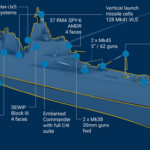
Germany SPY-6. Germany this month become the first international customer for RTX’s SPY-6 radar, picking the SPY-6(V)1 radar to be installed on eight of its F127 frigates via a foreign military sales contract with the U.S. Navy. In an Oct. 8 release, the company noted the contract would cover support and services to adapt the radar to this frigate’s design. SPY-6(V)1 has four array faces, each made of 37 radar modular assemblies for 360-degree coverage. The SPY-6(V)1 radar is known in the U.S. as the basis of the Arleigh Burke-class Flight III destroyer, which features various upgrade and design changes to field the advanced radar.
Launched Effects. Textron on Oct. 7 announced its Damocles launched effects offering, which it said utilizes the GEN2 Explosively Formed Penetrator (EFP) and is designed to provide top-attack, electronic warfare, and intelligence, surveillance and reconnaissance capabilities from the air or ground. “Equipped with autonomous tracking capabilities and advanced artificial intelligence, the Damocles LE provides operators with advanced capabilities, while maintaining the human in the loop for mission supervision and decision-making. The precision unitary munition ensures accurate targeting, making it a highly effective tool in mission-critical scenarios,” Textron said in a statement. Launched Effects is the Army’s program to field new attritable autonomous air vehicles that can be launched from aircraft or ground platforms with a variety of payloads and mission system applications to provide a range of effects for reconnaissance, extended communications links and eventually lethal capabilities.
Commercial Space Systems and Services. Space Systems Command (SSC) said that its Commercial SATCOM Communications Office joined the Air Force Working Capital Fund (WCF) under a new Enterprise Space Activity Group (ESAG) charter to increase commercial space systems and services. Col. Timothy Trimailo, the director of SSC’s commercial space office, said that the creation of ESAG on Oct. 1st “allows us to meet the uptick in warfighter demands and enables commercial vendors more flexibility to work with the Space Force, setting the stage for additional commercial services in the future.” Through the WCF, “customers pay for services, the WCF collects the reimbursements and that revenue is used to replenish the corpus, creating a revolving fund that does not depend on a continuous cycle of annual appropriations,” according to SSC. “This WCF required initial capital of $120 million as an activation deposit to start operations and is estimated to be valued in excess of $1.2 billion annually. The Commercial Satellite Communications Office is the only approved program under the ESAG charter to manage the WCF.”
SSN-798. HII’s Newport News Shipbuilding (NNS) division on Oct. 7 announced it completed initial sea trials for the new Virginia-class attack submarine Massachusetts (SSN-798). HII and the Navy tested systems and components of the boat, including submerging the submarine for the first time, and high-speed maneuvers both on the surface and while submerged. Testing is planned to continue at NNS before the submarine is later delivered to the Navy. SSN-798 was christened in May 2023 and is set to be the 12th delivered by the company.
SSBN Floating Dry Dock. Bollinger Shipyards and General Dynamics Electric Boat (EB) on Oct. 10 held a christening ceremony in Tampa, Fla., for the new ATLAS floating dry dock, which is expected to aid in construction, maintenance and sustainment of the Columbia-class ballistic missile program (SSBN). EB is the prime contractor for the new SSBNs as they replace the Ohio-class submarines. Ohio-class boats are due to start retiring in 2027. The ATLAS is 618-feet by 140-feet. Bollinger noted this completed its second contract with EB, following a 2019 award to build the 400 by 100-foot Ocean Transport Barge. Bollinger is currently building a pontoon launcher for EB, which will also support the construction and launching of the Columbia-class vessels.
Austal Loan. Australian shipbuilder Austal on Oct. 7 announced it received a $100 million loan from the Australian government’s export credit agency, Export Finance Australia, dedicated to improving construction of U.S. government vessels at its Mobile, Ala., Austal USA shipyard. A company statement noted this is specifically geared towards supporting its Final Assembly 2 project, with a loan term for 10 years “reflecting the long-term secured order book for ships that will be built in this facility, commencing with up to eleven US Coast Guard Offshore Patrol Cutters and up to seven US Navy Ocean Surveillance vessels (T-AGOS).”
SPY-1 Sustainment. Kratos Defense & Security Solutions, Inc. on Oct. 6 announced it won a million Phase 1 contract with a ceiling of $175 million to start developing an organic sustainment capability for the Navy’s AN/SPY-1 radar system. This radar system is currently used on the Navy’s Arleigh Burke-class Flight IIA destroyers and Ticonderoga-class cruisers. Internally, the company calls this Project Anaconda and it will later include multiple phases of work, noting the systems are projected to stay in service through 2065. Kratos said a major part of its solution is its new 155,000-square-foot Indiana Radar Integration Complex (IRIC), less than two miles from Naval Surface Warfare Center Crane. IRIC is set to be operational starting in 2027.
Shutdown Postponements. The Navy last Friday announced two missile industry days are being postponed due to the ongoing government shutdown, the Evolved SEASPARROW Missile New Variant Development Industry Day, scheduled for Oct. 14, and the Naval Modular Missile (NMM) Industry Day, planned for Oct. 21 and 22 at the Johns Hopkins Applied Physics Laboratory in Laurel, Md. The SeaSparrow notice said the postponement is until further notice while the NMM notice said a new date for the industry day will be identified and announced once operations have resumed and scheduling can be finalized again. “We recognize the importance of this event to our industry partners and apologize for any inconvenience this postponement may cause. NAVSEA and PEO Integrated Warfare Systems (IWS) remain committed to providing industry with the opportunity to learn more about the NMM program, its acquisition strategy, and collaboration opportunities once the event is rescheduled,” the Navy said.
NGC2. L3Harris Technologies said on Oct. 8 the Army has awarded the firm $24 million to supply software-defined data services in support of transport layer requirements for the Next Generation Command and Control (NGC2) prototype initiative. The company said it will deliver the new AN/PRC-158C NGC2 Gateway Manpack radio to the 4th Infantry Division, which is helping to inform NGC2 requirements. “The Army’s NGC2 program is too important to accept anything less than success in execution, including system protection against device compromise, external threats to the network and data spillage,” Sam Mehta, L3Harris’ president of Communication Systems, said in a statement. “We are the only industry partner delivering battle-proven, software-defined radio technology that meets the Department of War’s appetite for high-data throughput with the network security, resilience and integrity required to ensure battlespace supremacy against any enemy daring to test America’s military might.”
Power For FLRAA. Marotta Controls said on Oct. 7 it has been selected by Bell to provide the static inverter for the Army’s MV-75 Future Long Range Assault Aircraft (FLRAA). “This milestone contract award represents a strategic expansion for Marotta, introducing a new product category, establishing a relationship with Bell, and positioning the company within the U.S. Army’s advanced weapon system development program,” Marotta Controls said in a statement. “Development of the static inverter marks Marotta’s entry into DC-to-AC power conversion technology, completing the company’s comprehensive power systems portfolio.” Marotta Controls says the static inverter’s advanced power conversion architecture will support FLRAA’s “power distribution performance, enabling efficient operation of onboard systems while meeting stringent size, weight, and power requirements.”
Contested Logistics. The Flying Ship Company (FSC), which works on autonomous wing-in-ground-effect (WIG) cargo logistics, said on Oct. 7 it has been selected as a winner in the contested logistics portion of the Army’s xTechSearch 9 competition. FSC was granted an initial $25,000 award, with the potential to receive up to $250,000 in follow-up Phase 1 Small Business Innovation Research funding to continue prototype maturation demonstrations. “We are honored to be selected a winner in the U.S. Army’s xTechSearch 9 Competition, in which the Army recognizes FSC’s solutions as a potential game-changer for resupply, sustainment, and movement of materiel in adversarial environments,” FSC CEO and founder Bill Peterson said in a statement. “FSC’s autonomous WIG platforms travel low over the water, under radar and above sonar, and deliver large payloads on water or to flat shorelines, bypassing chokepoints and constrained harbor infrastructure.”
Schumer Amendment. A proposed amendment by Senate Minority Leader Chuck Schumer (D-N.Y.) to the Senate version of the fiscal 2026 defense authorization bill would have prohibited any fiscal 2026 spending on a Qatari 747 that the White House has wanted to convert for use as Air Force One, given construction delays for the latter. Yet, the amendment was not narrowly focused enough, as it would have banned fiscal 2026 funding of procurement or modification of any foreign aircraft for presidential airlift. The Schumer amendment failed on a party line vote in the Senate. Sen. Deb Fischer (R-Neb.), the chair of the Senate Armed Services Committee’s Strategic Forces panel, said that the Schumer amendment, if passed, would have a “negative effect on our U.S. nuclear deterrence” and that “the way the amendment is drafted would affect one of our military’s most important programs: the Survivable Airborne Operations Center” (SAOC). Last year, the Air Force awarded Sierra Nevada Corp. an up to $13 billion SAOC contract to modify Korean Air 747-8i aircraft to replace the E-4B “Nightwatch” doomsday planes by Boeing.
Lockheed Dividend. Lockheed Martin’s board last week authorized a nearly 5 percent increase in the company’s quarterly dividend to $3.45 per share, a 15 cent raise over the current dividend. The board also authorized the repurchase of up to $2 billion in additional company stock, bringing the potential repurchase program to $9.1 billion.
Medical Maven. Showing its chops beyond helping identify potential targets for operational commanders by applying computer vision technology to satellite imagery, the Maven Smart System was used in a recent training exercise to integrate combat casualty information to improve decision-making on “triage, evacuation, reconstitution, resourcing, and relative combat power,” Army Maj. Brian Lee wrote last week in Medium. Lee, the strategic advisor to the Army Surgeon General, wrote that service medical personnel integrated the Battlefield Assisted Trauma Distributed Observation Kit-Joint (BATDOK-J) in September at a training rotation at Fort Polk, La. BATDOK-J is a “joint force point-of-injury and enroute care documentation tool” to replace paper records, he says.
Havoc Raise. HavocAI last week said it has raised $85 million in additional capital it will use to scale its collaborative autonomous technology to new maritime vessel types and sizes, increase manufacturing capacity to meet U.S. military demand for thousands of autonomous vessels, and help the Rhode Island-based startup pursue international opportunities. The funding round includes new investors B Capital, In-Q-Tel, Lockheed Martin, Hanwha, Taiwania and others, and brings to nearly $100 million total capital raised by HavocAI.
…Hoverfly Raise. Hoverfly Technologies, a developer of tethered unmanned aircraft systems, last week said it raised $20 million in a funding round, led by Leonardo DRS, which contributed $15 million, with Korea Robot Manufacturing Co. (KRM) providing $5 million. KRM and Florida-based Hoverfly will partner to establish a new facility for U.S. production of key components to strengthen the domestic supply chain. Leonardo DRS, an existing partner of Hoverfly’s, will help expand production of the company’s Sentry tethered drone, and launch a new production line for the Spectre tethered drone.
Maritime Monitoring. Planet Labs last week said it has signed a $7.5 million contract renewal with the Navy to continue providing electro-optical satellite image detection and monitoring over key areas of the Pacific Ocean. The contract includes Planet’s PlanetScope data and SkySat imaging data that is integrated into the Transportation Department’s SeaVision maritime situational awareness platform. Planet will also leverage artificial intelligence technology from SynMax for vessel detections and other analytics.