Ukraine Aid Fund. Sens. Roger Wicker (R-Miss.) and Jim Risch (R-Idaho), chairs of the Armed Services and Foreign Relations Committees, respectively, said on July 30 they plan to introduce the PEACE Act that would establish a U.S. Treasury fund to collect NATO allies’ deposits to purchase U.S. military equipment for Ukraine. “The PEACE Act enables our European partners to finance replenishments so that the U.S. military can continue drawdown packages of weapons to Ukraine. This is the fastest way to arm Ukraine as well as to minimize the strategic and military threat posed by Russia to the U.S. and NATO. The PEACE Act, in conjunction with the purchase of new military equipment and the prospect of imposing a crippling sanctions regime, shows Putin that neither escalation nor attrition will allow him to achieve his war aims,” Wicker said in a statement. President Trump recently announced a new plan for NATO countries to purchase “billions of dollars” in U.S. military equipment for Ukraine via the foreign military sales process.
Hydrogen Power. The Defense Innovation Unit last week said it has awarded Pratt Miller a one-year, $3.8 million contract to prototype their solution for the Expeditionary Hydrogen On Ship & Shore (EHOSS) project, a containerized hydrogen generation and fuel solution to bolster energy resilience, reduce fuel supply logistics vulnerabilities, and enable distributed operations in austere environments. Pratt Miller, a unit of Oshkosh Corp., has different programs for hydrogen fuel cell integration for contested logistics. “EHOSS is a step toward enabling persistent, low-signature operations that can help us untether from larger fuel supply chains and adapt across the maritime and littoral fight,” Andrew Higier, DIU energy portfolio director, said in a statement. DIU is working with U.S. Indo-Pacific Command, the Marine Corps Expeditionary Energy Office, and other on EHOSS.
Leidos Biometrics Work. Leidos, the prime contractor for the FBI’s authoritative biometric and criminal history repository, received a $128 million task order from the bureau to provide agile software development and modernization of the system. Leidos last week said it will provide mobile apps, biometric algorithms, automated testing, and integration of other emerging technologies for the Next Generation Identification system. The systems accuracy for fingerprint identification now exceeds 99.6 percent, Leidos said. The task order has a one-year base period and four one-year options.
eVTOL Funding Raise. Israeli startup AIR has raised $23 million in a Series A round to expand its crewed and uncrewed electric vertical takeoff and landing (eVTOL) aircraft production to meet growing purchase orders and accelerate expansion in the U.S. AIR said its uncrewed cargo eVTOL is designed for cargo delivery, disaster response, contested logistics, and remote access operations, and can travel 100 miles at up to 120 knots. The aircraft has a 550-pount payload capacity.
Space AI. Slingshot Aerospace has unveiled TALOS, an artificial intelligence-enabled tool “to imitate realistic satellite actions in training and simulation environments.” The Thinking Agent for Logical Operations and Strategy “learns and replicates real-world spacecraft tactics such as representative behaviors, space warfare maneuvers, and dogfighting strategies.” TALOS was developed through the company’s collaboration with the Space Force’s Operational Test and Training Infrastructure and the company’s virtual environments. “Space has become an integral warfighting domain, and AI-powered training and simulation capabilities will ensure the U.S. and its allies are prepared for any relevant warfighting scenarios,” Tim Solms, Slingshot’s CEO, said in a statement.
CISA Nominee. The Senate Homeland Security and Governmental Affairs Committee last week approved the nomination of Sean Plankey to be director of the Cybersecurity and Infrastructure Security Agency by a vote of nine to six. Plankey’s nomination now goes to the full Senate.
F-35C. A U.S. Navy F-35C with the VFA-125 “Rough Raiders” squadron crashed on July 30 near Naval Air Station Lemoore, Calif. The pilot ejected safely, according to the Navy. So far, the only other Class A mishap this year of the Lockheed Martin F-35 was the crash of an F-35A on Jan. 28 at Eielson AFB, Alaska Unit costs for the F-35B vary between more than $80 million for the conventional take-off Air Force F-35A and more than $105 million for the short take-off and vertical landing U.S. Marine Corps F-35B. “As F-35s have aged, their availability and use have decreased,” according to a June report by the Congressional Budget Office. “The availability and use of F-35s have been lower, in some cases much lower, than those of other fighter aircraft of the same age. For example, the average availability rate of a 7-year-old F-35A has been about the same as that of a 36-year-old F-16C/D and a 17-year-old F-22. The availability of the Navy’s F-35Cs has been closer to that of its earlier fighter aircraft at the same age.”
New VCSO and Head of AFGSC. The Senate on Thursday approved two key promotions for the Department of the Air Force–Vice Chief of Space Operations Gen. Shawn Bratton and Air Force Gen. Stephen Davis as the new head of Air Force Global Strike Command (AFGSC). Bratton replaces Gen. Michael Guetlein who is now in charge of the Golden Dome missile defense program, and Davis is to replace Gen. Thomas Bussiere, a decorated B-2 pilot who will be the Air Force’s vice chief of staff.
Largest AMRAAM Award. On Thursday, the Air Force awarded RTX’s Raytheon site in Tucson, Ariz., an up to $3.5 billion contract to build Advanced Medium Range Air-to-Air Missiles (AMRAAMs) for Ukraine, Poland, Finland, Denmark, Sweden, Lithuania, Germany, Taiwan, Japan, Canada, Belgium, the Netherlands, Spain, the United Kingdom, Australia, Switzerland, Israel and Kuwait. RTX said that Thursday’s AMRAAM award is the largest in the program’s history. “AMRAAM is integrated on 14 platforms in 44 countries and has had exceptional success in active conflicts,” RTX said.
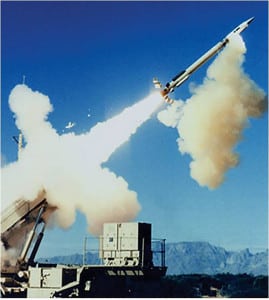
$2 Billion THAAD. The Missile Defense Agency awarded Lockheed Martin a nearly $2.1 billion fixed-price incentive (firm -target) modification contract line-item on July 28 to produce more Terminal High Altitude Area Defense (THAAD) interceptors. This increases the value of the larger contract from $8.35 billion to $10.4 billion. The award covers production work at facilities in Dallas, Texas; Sunnyvale, Calif.; Troy, Ala.; and Camden, Ark., and is expected to be finished by December 2029. Of this modification, $285 million in fiscal years 2024 and 2025 procurement funds was obligated at the time of award. This award comes after a large portion of U.S. missile interceptors were used to help defend Israel during the recent Israel-Iran conflict. A recent CNN report noted during the actions the U.S. expended about 25 percent, or 150, of its THAAD interceptor stockpile.
…Rate. According to DoD’s FY 2026 budget request documents, the Missile Defense Agency said it plans to procure 37 more THAAD interceptors in the next year, split between 25 in discretionary funds and 12 in the reconciliation bill. The documents said it expected a single contract award for 37 interceptors in FY ‘26 to cost about $12.4 million per interceptor unit. At similar rates, the new $2.1 billion modification to resupply interceptors more than makes up for the 150 or so used in the past year.
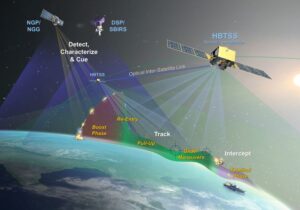
Rugged Golden Dome. Core Systems announced on July 29 it is supporting Lockheed Martin in its part of the Golden Dome missile defense program via ruggedized hardware systems. The company said this started by being chosen to deliver ruggedized rack infrastructure for the Long Range Discrimination Radar in Alaska. Core Systems noted several rugged tactical platforms it has available and in use by the U.S. military for these kinds of multi-domain operations, like the server-grade RPS417 Rugged Laptop, Tactical GPU Systems built with NVIDIA GPUs, and the ATMOS Tactical Edge Node.
Reloading At Sea. The Government Accountability Office on July 24 published a new restricted report, titled “Reloading Ship Missiles at Sea: Improved Strategy Would Better Position the Navy to Deliver Capability.” As a restricted report, GAO noted the report was determined to either include classified information or controlled unclassified information by the audited agencies, so it cannot be publicly released. The Biden administration’s Secretary of the Navy, Carlos Del Toro, pushed development and demonstrations of the Transferrable Reload At-sea Method (TRAM) on an underway warship. More recently, in July naval cargo handlers performed a vertical launch system missile reload evolution between the SS Gopher State (T-ACS 4) and USS Farragut (DDG-99), as part of Large Scale Exercise 2025 (LSE 25). In that event, the Gopher State used its heavy lift cranes to transfer missiles canisters simultaneously to DDG-99’s fore and aft VLS cells.
Skydweller. The Navy on July 29 announced the Naval Air Warfare Center Aircraft Division (NAWCAD) worked with Skydweller Aero to perform a nonstop three-day continuous solar-powered unmanned flight test out of Stennis, Miss. The company is based in Oklahoma City, Okla., and has research and development facilities in Mississippi and Spain. The Navy said the 73-hour flight proved Skydweller’s ability to maintain a continuous solar-powered operation and demonstrated the feasibility of achieving a “positive energy balance to power the aircraft during extended flights.” This also validated the system’s communication links, autonomous real-time decision making and ability to adapt to rough weather. The service noted this marks the potential for this kind of system to contribute to maritime intelligence, surveillance, and reconnaissance (ISR), especially as it could help provide wide-area surveillance over extended periods. NAWCAD first started experimenting with Skydweller’s solar-powered UAS systems in 2020 to help U.S. Southern Command (SOUTHCOM) operational challenges and later this summer they plan for further testing in the SOUTHCOM area of responsibility.
T-45 SLEP. The Navy on July 22 announced the Fleet Readiness Center Southeast (FRCSE) inducted its first two T-45 Goshawk aircraft into the Service Life Extension Program (SLEP) production line, 13 months after the Navy identified this requirement. The Goshawk is the primary two-seat jet trainer used by the navy and Marine Corps for pilot aircraft carrier qualification testing, a mandatory certification before flying other carrier-capable aircraft. Of these two, one will swap wings with a fully repaired set while the other will receive the full scope of SLEP work. FRCSE ultimately expects to conduct T-45 repairs through 2036.
Large Scale Exercise. The Navy and Marine Corps started the third Large Scale Exercise (LSE) 2025 on July 30, one of the Navy Department’s largest global training events. LSE 2025 includes Sailors and Marines across 22 time zones, six component commands and seven numbered fleets. The event aims to simulate realistic complex threats from piers of Navy bases, ships at sea and in headquarters, “without physically wearing down our ships, aircraft, and equipment,” the Navy said in a statement. The latest scenario is almost entirely virtual and builds on LSE 2024, but for the first time includes international partners Canada, Japan and NATO to coordinate and strengthen interoperability. “This isn’t just about scale—it’s about integration, synchronization, and rehearsal for the full spectrum of conflict. LSE 2025 will test our ability to globally coordinate Maritime Operations Centers (MOCs), execute contested logistics, and mobilize our Reserve forces,” Vice Adm. John Gumbleton, deputy commander of U.S. Fleet Forces Command, said in a statement.
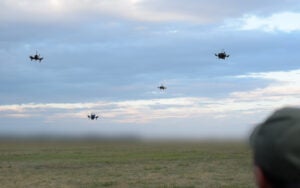
UAS Marketplace. The Army in mid-September will host an industry day in Huntsville, Alabama to detail its new UAS Marketplace concept for acquiring drones. “The UAS Marketplace will create an environment of continuous competition across multiple domains, increasing opportunities for a wide range of companies and organizations with the end goal of accelerating capability to soldiers,” the Army wrote in a notice. “Unlike traditional, long-term contracts with limited vendors and costly upgrades, the UAS Marketplace fosters open innovation and innovative business approaches by allowing any qualified industry partner to contribute.” The forthcoming industry day will cover the Army’s interest and the UAS Marketplace’s focus on air vehicles, payloads, software, integration and manufacturing for drone capabilities.
Israel Arms Sales. The Senate on July 30 defeated a pair of measures introduced by Sen. Bernie Sanders (I-Vt.) to block arms sales to Israel, while the proposals received support from more than half of the upper chamber’s Democrats for the first time. Sens. Jack Reed (D-R.I.) and Jeanne Shaheen (D-N.H.), the top Democrats on the Armed Services and Foreign Relations Committees, respectively, joined 25 Democrats in voting for a resolution to stop a $675 million arms deal to Israel that includes shipments of bombs. Shaheen, in a statement, said Israel “has not conducted its military operations in Gaza with the necessary care required by international humanitarian law.” “It is also clear that the Government of Israel has failed to allow adequate humanitarian assistance into Gaza, resulting in unbelievable suffering,” Shaheen said.
NGSRI. Kopin said on July 31 it has received a contract to continue developing the Visual Display Subsystem for Lockheed Martin’s offering for the Army’s Next-Generation Short-Range Interceptor (NGSRI) program to develop a Stinger missile replacement. Under the Phase 2 award from Lockheed Martin, Kopin said it will deliver “fully assembled ‘All-Up Round’ units-VDS assemblies for use in a variety of simulated and operational missile launch test scenarios.” “This update funds the build and test of the new high-resolution VDS assembly that includes Kopin’s proprietary organic light emitting diode (OLED) microdisplay, drive electronics and optical designs for integration into the Command Launch Assembly-a key system in the Army’s NGSRI initiative,” Kopin said in a statement. The Army in 2023 selected Lockheed Martin and RTX for the NGSRI competitive effort to develop a replacement for the Stinger missile, which has been manufactured by RTX.