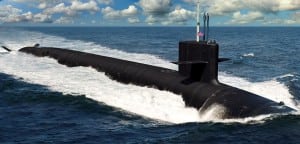
An artist's rendering of the U.S. Navy's future Columbia-class submarine. (Image: U.S. Navy )
A top Navy official confirmed the service is looking to fund the upcoming Columbia-class nuclear-armed ballistic missile submarine program (SSBN) separately from the normal shipbuilding budget.Vice Adm. William Merz, Deputy Chief Of Naval Operations for Warfare Systems (OPNAV N9) told reporters following a Senate Armed Services Seapower subcommittee hearing on Nov. 27 that discussions to move Columbia funding outside the traditional shipbuilding account is “becoming more active” as the horizon of construction set to start in fiscal year 2021 gets…
Defense Secretary Pete Hegseth said Wednesday the Trump administration plans to continue its push for at least $350 billion in defense funds via the reconciliation process “regardless of what happens […]
A small, bipartisan group of senators is backing the Fast Tracking European Investment in Ukraine’s Defense Act, S. 5175, to hasten the export of allied buys of U.S. munitions for […]
Rep. Jim Himes (D-Conn.), the ranking member of the House Permanent Select Committee on Intelligence, plans to increase the committee’s contractor oversight if the Democrats win control of the House […]
A new Congressional Budget Office report estimates the cost of the Iran war through Aug. 1 as $38 billion and says that the U.S. has likely depleted between one-half and […]
A top Navy official confirmed the service is looking to fund the upcoming Columbia-class nuclear-armed ballistic missile submarine program (SSBN) separately from the normal shipbuilding budget.
Vice Adm. William Merz, Deputy Chief Of Naval Operations for Warfare Systems (OPNAV N9) told reporters following a Senate Armed Services Seapower subcommittee hearing on Nov. 27 that discussions to move Columbia funding outside the traditional shipbuilding account is “becoming more active” as the horizon of construction set to start in fiscal year 2021 gets closer.
An artist’s rendering of the U.S. Navy’s future Columbia-class submarine. (Photo: U.S. Navy )
“To be clear, the Columbia is the number one program. The Columbia will be funded, it’s really the impact on the rest of the shipbuilding account that we have to negotiate how we’re going to cover down,” Merz said.
He said there is support in the Navy, Pentagon, and Congress for pulling the funding out of shipbuilding.
“I think everybody appreciates the fidelity of the last shipbuilding plan to highlight that, the storm is coming, it’s beyond the FYDP [five-year Future Years Defense Program], so it’s typically outside the near-term horizon.”
Merz said that since the Navy laid out the details of the future fleet in the 2018 30-year shipbuilding plan, “hopefully that’ll posture us for the Columbia challenge, other challenges that may be coming that we could get into position to handle before it’s a panic, before its already on top of us.”
Congress funded the Navy shipbuilding account at $24 billion in the FY ’19 appropriations budget, but that is both higher than the recent average and only includes advance procurement for the first Columbia-class boat. Full serial production will be higher and start in several years.
The Navy is planning to build 12 of the SSBNs at a total acquisition cost expected to be over $100 billion. The Navy estimates the lead vessel will cost about $8.2 billion while each follow-on boat is estimated at $6.5 billion (Defense Daily, Sept. 5).
In May the chair of the House Armed Services Seapower subcommittee Rep. Rob Wittman (R-Va.) pushed for the FY ’18 shipbuilding defense authorization level of $26 billion to be maintained to increase the fleet size. He said Congress would have to add an extra $3 billion when Columbia starts production.
Wittman said that is doable if funded on a proper timeline and scale to ensure the Navy uses advanced procurement and an economic order quantity “to make sure that it’s a sustainment ramp to get there” (Defense Daily, May 10).
NATIONAL HARBOR, Md. – A Senate Armed Services panel chair today said boosters of the Golden Dome program still have work to do to increase support on Capitol Hill while […]


 By
By